
Trusted since 2003 5-star rated locally owned
Trusted Since 2001 & 5 - Star Rated
NO CONTRACT REQUIRED
Family-Owned & Operated
MOSQUITOS

Mosquitos are known for their irritating bites and role as disease carriers. They thrive in warm, humid environments and breed in stagnant water, making backyards and gardens prime locations for their development. Mosquitos can disrupt outdoor activities and pose health risks by transmitting diseases like West Nile virus and Zika. Effective pest control measures, such as eliminating standing water and using repellents, are crucial in minimizing their impact.
Pest Control
Mosquitos


PROTOCOL
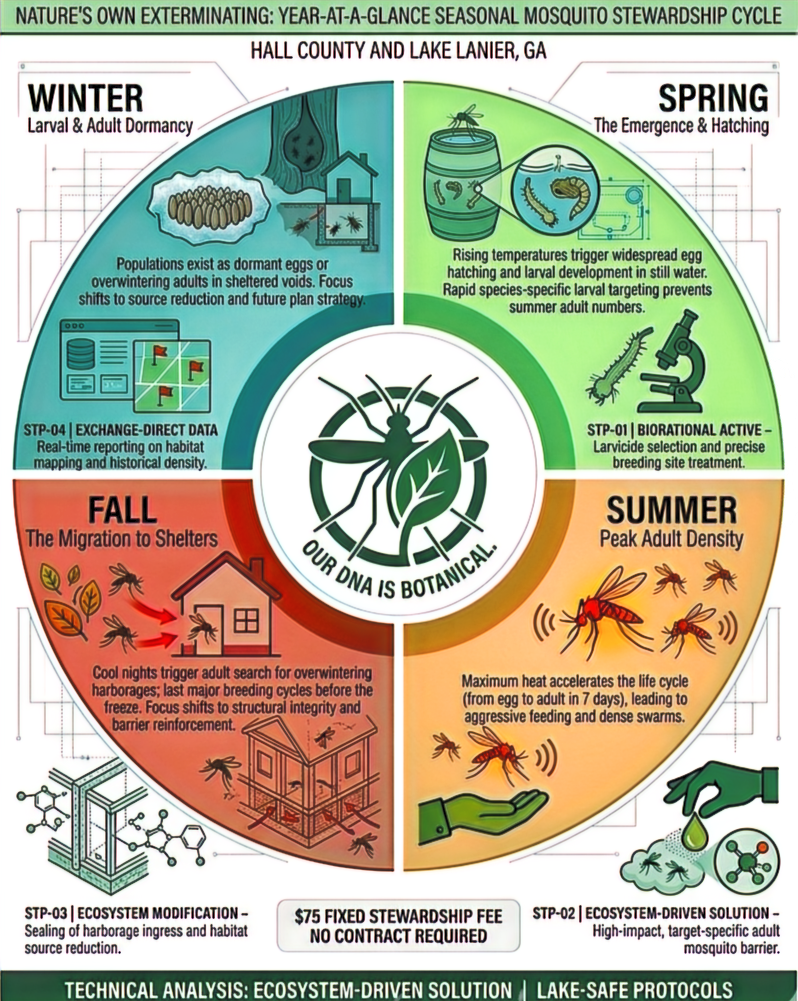
LAKE LANIER STEWARDSHIP CYCLE
Scientific Botanical Mosquito & Tick Management for Hall County
EARLY SPRING
Rising Lake Levels
Rising Water Line
Heavy rains raise the lake line, activating dormant eggs in the floodplains.
Action:
Pre-emergent botanical barrier at the shoreline
PEAK SUMMER
High Humidity Bloom
Evaporation Peaks
High evaporation around Hall County creates micro- climates for rapid breeding.
Action:
Bio-rational fogging using essential oil molecules.
LATE SUMMER
Receding Shoreline
Stagnant Cove Pools
Dropping water levels leave stagnant pools, creating high-density breeding zones.
Action:
Targeted stewardship of newly exposed breeding areas.
AUTUMN SHIFT
Leaf Litter Cooling
Humidity in Foliage
Moisture in leaf litter keeps ticks active as mosquitoes begin to go dormant.
Action:
Transition to perimeter tick exclusion & habitat prep.
Facts
-
The Atlanta Metro Big Three: Out of 3,500 global species, the three driving your backyard crazy in Georgia are Aedes, Culex, and Anopheles mosquitoes.
-
Only Females Bite: Both genders feed on sweet plant nectar, but females require the specific proteins found in blood to successfully develop their eggs.
-
How They Target You: Mosquitoes use advanced heat sensors to locate your closest blood capillaries, tracking your body heat, sweat, and the CO2 trails left behind when you exhale.
-
The Dark Clothing Trap: Avoid dark colors during peak seasons—darker clothing retains more ambient heat, causing you to sweat more and signaling an easy meal to nearby pests.